Minimalism as a Method for Reducing Mental Fatigue
(with a special focus on autistic burnout and minimalistic software recommendations)
2026/02/17
Introduction
As an autistic person, something that I struggle with navigating every single day is sensory overload and general mental fatigue. At its worst, it leads to extensive burnout, and severely hinders my ability to function in the ways I would like to. Whilst attempting to find solutions to these problems over the years, I've found minimalism (as I understand it) to be an incredibly helpful framework. I believe that as a system it has a broad appeal that could extend to all individuals, not just those who are neurodivergent — even if it might prove especially helpful to the latter.
We live in a time period in which being bombarded incessantly with information is commonplace, and burnout seems to me to be incredibly common. A lot of the systems that I encounter regularly appear to be designed almost from the ground up to be distracting and overstimulating, and I have a very limited capacity for dealing with them. I've noticed a general frustration in many others whenever observing them handling these systems, as well. Whilst additional features are not always inherently bad or unnecessary, I've become very interested in trying to find and support minimalist alternatives, and much more often than not find that I vastly prefer them.
As someone who is especially sensitive to this kind of overstimulation, I've spent a lot of my time experimenting with different methods of reducing clutter in just about any aspect of my life I could think of: whether it was my diet, my smartphone usage, my daily habits and routine, my physical possessions, or even this website layout.
'Decluttering' exists and can be interpreted and practiced in many forms, and in this article I want to share some of the ways in which I attempt to do this in my life, and the resources and tools that I feel help me to achieve more mental clarity, energy, and productivity.
Not everybody will enjoy living with as little variety as I do (even I still value variety and believe it is important — I love to travel, and I believe that actively seeking out new experiences is often very good for personal development), but even if you don't thrive on a lack of variety, I think a minimalistic framework can still be incredibly helpful insofar as it is utilised as a mindset that revolves around 'removing the things that don't matter to allow more space for what does'. This is an approach that I believe is applicable to every single lifestyle, even if it may be one that involves a level of possessions or variety that may at first not seem conventionally minimalistic — it will look different for every person depending on what they value. It's a flexible framework built on a foundationally reliable and helpful premise.
Why It Helps
Whenever a person is experiencing mental fatigue or burnout, the goal is generally simply to reduce demands in whatever way is possible. I find minimalistic habits and resources incredibly helpful for this, as they allow for a reduction of sensory or informational input, meaning that the quantity of information that must be processed is significantly lowered.
This lowered requirement for energy expenditure on processing information means that space and energy can be retained and redirected towards recovery, allowing people to refocus on the things that really matter to them and reduce mental fatigue.
Doing one's best to identify the things in their life that vampirically drain their capacity and energy, then removing or minimising them is, to me, what minimalism is fundamentally about. These things will look different for every person, but the premise remains the same.
Special Relevance in an Autistic Context
It is commonly accepted that in autistic people, whilst they can often appear to be functioning normally and handling external stimuli in a functional way on the surface, there tends to be a much greater deal of mental strain occurring internally due to various abnormalities: 'even when people with autism produce normal behavioural output, they tend to do so by abnormal physiological means'1.
As autistic people tend to experience less automaticity in the processing of information in general, especially in relation to prosody, social cues, or sensory input, there is an increased need for energy expenditure and an increased risk of mental fatigue. This is why the term 'high-functioning' is, in my opinion, rather misleading: autistic people may appear to be functioning 'well' on the surface, but there are almost always hidden mental taxes and costs that are accumulating mentally or physically2.
Personally, my mental fatigue manifests very frequently in physical symptoms of distress through autonomic system malfunctions, resulting in nausea, chronic pain, difficulty breathing, and various other symptoms. These make my quality of life much worse and directly affect and hinder my daily functioning, even if not always in an incredibly externally visible way. In the long-term, without careful management or 'treatment', my health would gradually become worse to an unsustainable point and debilitate me in various ways, such as by causing nausea and vomiting so chronic I would develop further eating difficulties, experience sustained weight loss, and become impacted by general nutritional deficiencies. For some people, this isn't just about comfort or convenience: it's directly connected to actual physical health.
I believe that because of the increased strain that autistic people incur due to their decreased automaticity in relation to processing information, minimising informational inputs is a genuinely helpful and sustainable long-term management system. It's not a flawless solution, but it makes an actual difference. This is what utilising minimalistic methods in an autistic context means to me.
The fact that these issues are not specific to me but seem almost universal amongst autistic people (and even the non-autistic population), albeit in varying degrees of severity, implies to me that the topic should be discussed more. That is what I am attempting to do with this article.
Forms of Minimalism I Practise
Digital Minimalism
Digital clutter is probably the form of clutter that causes me the most stress and fatigue. For me, this involves social media feeds, most short-form content, unnecessarily convoluted GUIs, unintuitive software applications, and notifications or the idea of being 'constantly available'.
Whilst I love seeing people using websites and digital interfaces as a form of self-expression, and there's an immense amount of value in that, I also really value websites being content-focused and accessible. Whilst my website doesn't contain a great deal of graphics or colour, I don't feel it is lacking any form of self-expression because of this; this is simply what I value and what brings me fulfilment.
Generally, I avoid using social media platforms (although I'm not always hard-line about this), and I avoid using applications that I feel are bogged down with unnecessary features, which I consider bloat. Telegram has integrated stories, which I see as pointless; Discord has paid cosmetic features and servers, which I scarcely ever enjoy utilising or feel a need for; YouTube has become oriented towards pandering with short-form content, which I find insidious.
My priorities for determining the digital software that I choose to use and rely on are as follows, in no particular order: how minimalistic and practical the GUI is; how bloat-free it is; how private it is; how well it functions at the tasks it sets out to do; whether or not it is open-source; how pleasant the interface is to navigate and look at; and, finally, whether or not I can actually convince anyone to use it to communicate with me. ("What do you mean you don't want to learn to use an obscure CLI client to chat with me?!")
Finally, I tend to mute every application and chat on my phone, and I perpetually keep it on silent. I don't like the idea of being constantly accessible, and abrupt notifications or interruptions further dysregulate me.
I'll include recommendations for some software that I personally use, have used, or recommend later in the article.
Environmental Minimalism
This essentially just refers to the fact that I aim to ensure that any environment (that I can control) which I spend a substantial amount of time in is free of clutter. Mainly, this means visual clutter, but even 'hidden' clutter, as this can weigh on me in the back of my mind even if I'm not directly looking at it.
I like to know what exactly is around me and why I'm keeping it there. I want everything in my space to be intentional. That doesn't mean I want to own nothing, or be surrounded by nothing: I have a few stuffed animals I cherish, a few figurines, and a few scarce souvenirs. However, whilst I don't own or display many decorations, the few I do have I appreciate much more because of it. Instead of having a lot of things I only care about somewhat, I have a few things I cherish very deeply.
It's very similar to my perspective on including graphics on this site: the fewer I include, the greater impact the few that I do include have.
Dietary Minimalism
This links very directly to my difficulties with ARFID, but I find that establishing a predictable dietary pattern helps my health in just about every way possible. I've come to accept that having 'safe' foods isn't a weakness, and that eating something predictable that isn't as healthy as an alternative option is still healthier than starving or eating something I can't process at the time and vomiting later.
Having a predictable diet also helps with avoiding nutritional deficiencies, simplifying shopping trips, and reducing impulse purchases. Meal prepping can become a less daunting task, also. I think it's potentially very useful even for people without special dietary needs.
Having a Capsule Wardrobe
Owning fewer clothes is beneficial for me in a myriad of ways: I have less mental strain because I have fewer options to pick from, and I am less indecisive; I cherish the few clothing items I have more because I'm not distracted by an overload of choice; my clothes are increasingly functional and bring me greater joy because I have selected them so carefully; I can invest my money into quality, natural-fibre staples rather than a larger collection of mediocre fabrics; and, finally, I can reduce waste by not purchasing anything I don't need.
Now that I buy far fewer clothes, I can focus on making sure I buy strictly wool, cotton, and linen clothing. Natural fabrics make me happier, overwhelm me less because they aid temperature regulation, and are better for the environment.
Potentially the greatest benefit is that I have less laundry to do. (Man, I hate laundry.)
Focusing on Speech Patterns and Tone
This one is more niche, and probably seems strange. By focusing carefully on my intonation and the ways in which I deliver my words, I not only try to make it easier for others to process the information I am feeding to them, but I encourage myself to think more consciously about what I'm actually saying. I try to avoid making conversational missteps in this way.
I highlighted this earlier in the article, but it also appears that autistic people experience less automaticity in language processing, and thus simplifying speech patterns can reduce the mental load that people must bear whenever processing language. Some practical steps to achieving this might be reducing the use of ambiguous sarcasm, keeping one's tone of voice steady, and avoiding harsh or discordant pronunciations of sibilant or consonant sounds.
Another way that I tend to simplify my speech is by verbalising my emotions clearly, rather than assuming others will be able to accurately or 'automatically' infer them from my intonation. Whenever I am able to speak about my emotions and name them overtly, I am able to evaluate and handle my reactions better than whenever I simply express them in less controlled or clear ways. I tend to be happier with how I've handled situations in retrospect as a result.
Refusing to Save Possessions for a 'Special Occasion'
This one is quite self-explanatory, but I try to avoid purchasing or receiving items and then putting off using them for a 'more appropriate time''. Usually, whenever I do this, the items end up expiring or fading away into antiquity in a crevice or cupboard somewhere, and they never get appreciated the way they should.
I think it can also be an important mindset shift. 'Why isn't this worth cherishing right now? What would actually make a moment good enough to warrant utilising this?'
Returning to Familiar Media
Familiar movies, shows, books and music provide me with comfort and less mental strain because my brain isn't processing new information, necessarily; it's appreciating familiar information again, sometimes in new ways.
Altogether, whilst I love discovering new media (and everything good and familiar was once also new), whenever I'm having a particularly difficult time, relying on familiar sources of entertainment or information provides me with stimulation that doesn't often contribute to my overwhelm, but can instead calm it.
I guess this is sort of what 'comfort shows' are for. (My comfort albums include: any Gregory and the Hawk album. You should listen to them too.)
Scheduling and Simplifying Routines
Developing and utilising rituals or routines of behaviour reduces executive dysfunction related exhaustion for me. Whenever I don't have to think extensively about what I'll do, what order I need to do it in, and when I need to do it, I can focus more on the task at hand instead of trying to decipher how I'll actually put it into practice.
Every morning before work or school, I like to do the exact same things in the exact same order. Most people have standard routines like this, but finding ways to formalise or cement them can be a small way in which you can help yourself. I look for parts of my schedule and life in which I think I could establish reliable routines, and this familiarity brings me a great deal of comfort, clarity, and productivity.
Minimising Social Commitments and Communication Channels
I used to guilt trip myself, believing that if I wasn't socialising every weekend, I was being unhealthy and hindering my development somehow. My quality of life has increased drastically since realising and accepting that this is my life, that other people's standards shouldn't get to dictate what I do, and that I don't actually care what other people think about me locking myself in the house all weekend.
Having one consistent, reliable friend who I enjoy spending time with semi-regularly for short periods of time is sufficient for me, and I've come to accept that's okay. Learning to say 'no' to social engagement propositions has been crucial for me, also. I'm not entirely taciturn, and I'm absolutely not a shut-in, but I prefer to choose my social engagements more carefully now so that I can invest myself in and enjoy more fully the few that I do partake in. I have more energy to give to the people I truly love spending time with because I'm not expending it forcing myself to go to every social engagement offered my way.
Finding alternative methods of socialising has been helpful for me, too. Human beings are social creatures, and I don't believe it's healthy to lock yourself away completely, but I do believe that sometimes modifying the channels through which we communicate with others can be productive. I enjoy sending physical letters, writing long-form emails, and one-on-one communication, as all of these reduce the kind of mental strain caused by, for example, attempting to communicate with a large social group in person or many people simultaneously in an online server.
Opting for Reusable or Refillable Alternatives to Reduce Waste
This ties in neatly with my interests in holistic healthcare and natural alternatives, but by reusing products that I love, I save myself the stress of worrying about what to purchase, which new product to try, or whether it'll work as well as I want it to. I have staple items that I know I can rely on, such as refillable deodorants, beeswax wraps for food instead of plastic bags, and a safety razor that always performs just as well as the last time I used it.
By following this general rule, costs are reduced, shopping trips are simpler, and I'm able to help reduce harm to the environment by proxy. I can buy quality products that I know are reliable and work well. I also don't have to subject myself to new and potentially uncomfortable situations: patchy makeup products, cleansers that break out my skin, or razors that cause ingrown hairs.
Dedicated Use Technology I Recommend
Despite the fact that owning a single item that serves many functions (such as a smartphone) may seem more minimalistic, I don't believe it actually is. It becomes a tool for distraction, bogged down by unnecessary features, and it often performs these jobs in a significantly worse way that a dedicated use device would.
By opting for dedicated use devices, I find ways to focus my attention on the task at hand and improve general performance. I've decided to include a list below of the devices that I use and recommend, with model or product names attached.
Digital systems
- IEMs: In ear monitors. Almost everyone I know uses headphones or earbuds of some kind, but very few people I know use IEMs, or even know what they are unless they've worked in the music industry or are an audiophile. I bought a fairly affordable pair that my brother recommended to me (the Truthear x Crinacle ZERO: RED IEMs) and I've been incredibly happy with them. I'm mentioning them here because I find that the drastically improved audio quality that they provide whenever I'm listening to music encourages me to treat listening to music as a more deliberate action, and as a result I tend to enjoy it more. I find new enjoyment in old albums, and I'm more intentional about how I process and feed auditory information to myself because of them. Whenever I'm playing music through these, also, the PNC cuts out far more background noise than my Sony WH-1000XM4 headphones do, even with the ANC on. They have individual use cases (the Sony's are better for travelling and general comfort), but I recommend experimenting with IEMs, as even the lower-budget ones can provide a huge improvement and reshape your mindset about how listening to music should be approached and how enjoyable it can be.
- Portable music player and recorder: My portable music player is technically a field recorder that I initially got to use for recording lectures (it's the Olympus LS-P5), but I eventually began using with my IEMs to listen to music on-the-go as well because I can easily store high-quality FLAC files on it. It accepts SD cards for additional storage, so storage space isn't an issue. I like not relying on my phone for music files whenever travelling, because any instance in which I take my phone out is an opportunity for me to become distracted or overstimulated.
- eReader: I've discussed my reasoning behind this one elsewhere on my site, but the short story is that owning hundreds of physical books taught me the hard way that it's not sustainable if you move frequently, and ultimately, they tend to just gather dust. I'm happy to compromise with using digital files since I move so often and prefer to have fewer possessions, and I don't feel any special desire for the 'tactile experience' of reading a physical book, as I feel my eReader is capable of simulating it fairly well. I transfer local files to my eReader, and have it modded with a custom GUI that simplifies things, also. I own a Kobo Clara HD, and I've been using it for years with no problems or complaints so far. The battery life is brilliant, I can turn off artificial lighting, I can change font sizes, I can search books by words or phrases, and it survived the freezer fiasco of '22. (My father thought that it was a freezer pack and put it in the freezer for multiple days. Whenever we eventually discovered this and retrieved it, it still worked flawlessly, and has ever since. Poor eReader.)
- Digital alarm clock: This stops me from relying on my phone as an alarm, so I don't end up reaching for my phone first thing in the morning. It also doubles as a radio, which is a nice way to discover new music from time to time if I ever feel like it, although usually I avoid the news and radio channels because they're so spontaneous. I own and use the LOGIK LCRB25 FM clock radio, simply because it's what my local electronics store had whenever I went.
- Screen-free camera: I have a Fujifilm bridge camera as well as a Camp Snap screen-free camera, although I use the former less because it's much bulkier and can be more convoluted to use. The latter encourages me to focus on staying in the moment and capturing memories casually, rather than focusing intensely on altering settings or getting a 'perfect shot'. I often find the photographs I take with it are more pleasant to look back on because of that. I was raised by a photographer and I appreciate the art of photography and the enjoyment that some people receive from fine-tuning settings, but for most purposes, I find that this Camp Snap camera is perfect for me and provides incredibly quick and easy access to my photograph files whenever friends want copies of them. I used disposable film cameras for a while, but they become expensive quickly and aren't hugely sustainable.
- Local media files: Having a limited amount of files available to me encourages me to actually watch or listen to or read the media on my lists. I like downloading the media I consume so that I don't have to rely on external streaming platforms. These are frustrating for a variety of reasons, and can be overwhelming because they bombard you with so many options that it's easy to develop a kind of paralysis and not know what to choose. I also like not having to buffer files.
- Flashlight: I reach for my smartphone a lot to use it as a mediocre flashlight, so I bought a small, portable flashlight to use as an EDC (everyday carry). My goal with most of these items is to prevent me from reaching for my phone. I use a Nebo Slim Mini, and it's brilliant at what I need it to do. It has a surprisingly high lumen output for the size, the price point is good, it's incredibly compact, and it has a magnetic strip at the base that makes it incredibly convenient for using whenever I'm reorganising my PC cables. You can even attach it to the inside of the hood of your car during maintenance or repair work.
- Handheld console: I own a 3DS and a Switch, although I don't actually take them out of the house often. I'm not that invested in gaming. I like playing video games, but I'm more than happy for it to exist only in one physical space in my life. Nonetheless, this is a necessary reference to handheld gaming consoles if you're into that kind of thing, because they're still awesome devices conceptually, even if I don't use them that frequently. (My Switch is perpetually docked.)
- Dumbphone: Honorary mention, because I semi-want one but don't actually own one. I'm somewhat afraid of losing my smartphone's real-time public transport timetables and updates, and whenever I'm travelling internationally I'm not always able to print out boarding passes, so digitising these simplifies the task lists I have and items I need to carry on me. I also appreciate the GPS/Maps features whenever I am in a foreign place, and they're useful for navigating new places in general. I'm currently trying to decide whether I should stick with my dumbed-down and customised smartphone, opt for a 'dumbish' phone with modern features but severe restrictions on things like social media, or commit to the dumbphone life. The middle option seems unnecessarily expensive, and the final one too restrictive, so I'm just trying to exercise self-control with the first for now. I think that's a good compromise for most lifestyles, and custom launchers like Olauncher (mentioned later in this article) make it more viable. My old housemate used a Unihertz Jelly Star phone, which might be something you find interesting if you're interested in limiting your smartphone usage but retaining most functionality.
Analogue systems
- Snail mail: There's something special about receiving a tactile letter in the mail, and I enjoy the patience and thoughtfulness that handwriting letters and waiting for a response teaches you. There's a clear focus on communicating information thoughtfully rather than messaging one another 'just because' or out of boredom, and the fact that you're not viewed as constantly accessible in the way you might be on a social media or instant messaging platform can encourage healthier mindsets about communication. I also find that writing my thoughts down by hand helps me to process and communicate them more effectively.
- Modular notebook system: Taking notes digitally has strengths, like being able to organise files thoroughly, edit them easily, and avoid physical clutter, but modular notebook systems (like a Traveller's Notebook) can also prevent distractions that you would otherwise often experience whilst attempting to write on a digital interface. When you're using a computer or a phone, distractions are literally right at your fingertips, and most people (myself included) don't handle that incredibly well. Physical notebooks can improve focus, and modular notebook systems allow you to pick and choose exactly what formats work best for you.
- Wristwatch: These can also be digital, but it doesn't matter much, as long as it's not a smartwatch. Wearing one stops you from constantly checking your phone for the time. I don't actually wear one because they give me sensory issues, so maybe I'll get a pocket watch like a nerd someday. Either way, if you can tolerate them, they're good to have.
Software I Recommend
Attached below is a list of software that I personally enjoy using because I find it does its job especially well, has a minimalistic GUI, is safe and secure, or is some combination of the above.
Media players
- MusicBee: If I can't see the cover of an album visually, I often forget it's even there in my files, and it simply becomes clutter. I love MusicBee for its album view feature, and I like using it because it encourages me to focus on the quality of my music (as I'm storing my music in local files) and helps me to focus on enjoying albums holistically. Playlists full of different songs can often result in whiplash, harsh tonal shifts, or general inconsistency that I'm not always looking for whenever I want to listen to music, so I scarcely use the playlist feature.
- mpv: No matter how many other video or media players I try, my heart will always belong to mpv. It just works, man. (Infinitely better than the common alternative...)

Communication platforms
- Toxic: I don't actively use this right now, but this is a terminal-based/CLI client for Tox, a peer-to-peer, end-to-end encrypted instant messaging protocol. It's delightfully barebones, and I used to love using it, even if it took me a while to get used to.
- Signal: I'm not informed enough to know exactly how secure this is as a messaging platform, but from what I'm aware it's a solid alternative to something like Telegram (which does not have E2E encryption by default, for some reason) or Discord (a giant mess). Telegram has some nice features like stickers and very accessible and intuitive file-sharing, but in general, Signal is simpler, and I don't see the lack of features as an inherently inferior thing.
- HexChat: I don't actively use IRC anymore, as once again, I have no one to communicate with there, but whenever I did I used HexChat. It was simple, it did its job, and I enjoyed using it. I never looked heavily into other clients due to my limited experience with IRC in general.
- Neocities: This one is obvious, but I love Neocities because it shifts focus away from short-form content, incredibly proprietary platforms with restrictive interfaces, and encourages thoughtful individual self-expression. Navigating people's websites here is a joy for me, and I find it far more insightful and pleasant than I've ever found navigating even the most carefully curated social media feed. I love everything that it stands for, and I'm very grateful this platform exists.
- Mumble: This is a free, open source voice chat application. Once again, this is something I haven't used in quite a while (mainly due to the fact that I find the idea of navigating setting up a server more daunting than I probably should), but I've spent a lot of time voice chatting with friends on this in the past, especially those I met via IRC.
Scripts and extensions
- 4chan X: I enjoy using this script to modify the GUIs that I interact with and view whenever I'm using imageboards, for example by changing margin sizing, allowing for image previews with cursor hovering, and utilising dark themes to prevent visual strain caused by bright colour schemes. I can make imageboard layouts personalised and consistent, which matters a lot to me.
- DarkReader: This is very similar to my explanation for the above. This browser extension automatically transforms navigating bright website layouts into a less overstimulating experience. I turn it off whenever I'm navigating Neocities sites, because I like to see them exactly as the creator intended, but for general browsing, it's a great tool.
- Vimium: This is a browser extension that provides keyboard-based navigation so that you don't have to utilise your mouse as often, if at all. I still like to use my mouse for things like hovering over images on imageboards for previews, but in general, using keyboard shortcuts and input to navigate webpages is faster and less stimulating for me.
- uBlock Origin: A free and open-source browser extension for content filtering, including advertisement blocking. Pretty self-explanatory. Advertisements and pop-ups are irritating and disruptive.
Other
- Olauncher: This is the launcher that I use on my Android smartphone to 'dumbify' it somewhat. It allows me to reduce visual clutter and create a custom homescreen that suits my individual needs and reduces potential distractions. I have an article on the site about how I did this here.
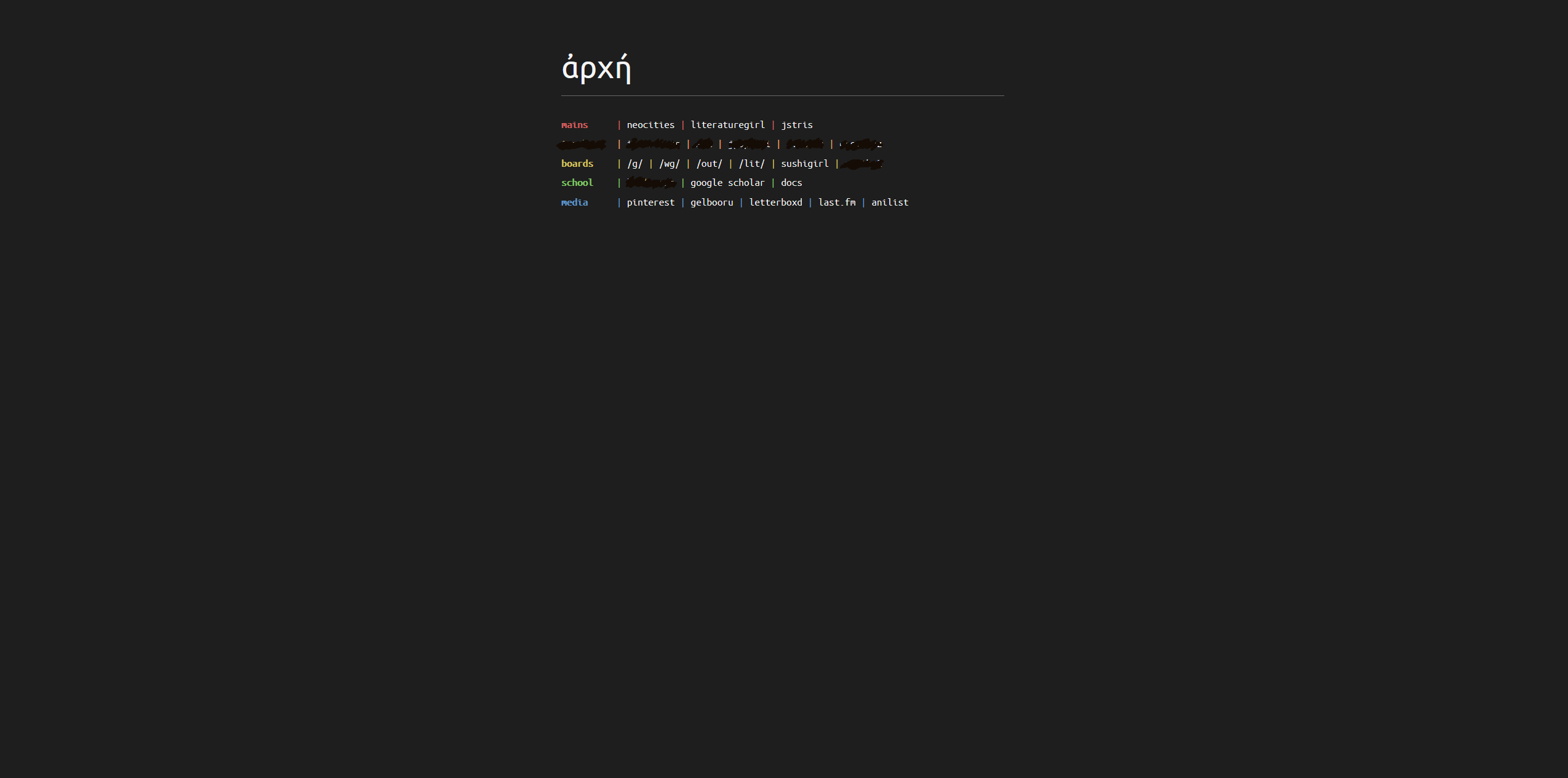
- Custom browser startpages: I love making these so much. If you're unfamiliar, this is basically just something I do where I redirect my browser to open a specific HTML file on startup that includes basic HTML and CSS and a series of hyperlinks to sites that I regularly frequent or want to have easy access to. By having this as the first thing that greets me whenever I open my browser, I tend to choose to spend time on websites I actually find engaging and rewarding, as opposed to ending up browsing something fairly inane or unnecessary. I've censored some names for privacy reasons, but this is what my startpage looks like.
- Sergey: This is a minimalistic, simple, clean little static site generator that an old friend showed me and which I have used for this site. I haven't experimented with much else in the way of static site generators, but I've felt no need to change from this. It simplifies the process of updating certain aspects of the site and makes it less mind-numbing than manually changing every HTML file. (I have subjected myself to this also...)
- Firefox: This is a controversial pick, probably, but I have a few reasons for it. I've customised my specific install of Firefox so much over the years that I'm happy with it as it is right now, and whilst I've tried a lot of other browsers (Ungoogled Chromium being an example off of the top of my head), they always have their own issues. Firefox is, as I have it customised now, incredibly clean and simple and pleasant for me to navigate. Firefox isn't great in many ways by default, but ultimately, you're trading off for other issues if you opt for a more privacy-oriented browser that's more niche and will likely have less support or maintenance in the long-run. Picking a browser is a very individual thing. I'm open to being persuaded to try something new, but from my experience so far, this works best for me.
1. Autistic compensatory processing. (Reference in this article.)
2. Reduced automaticity in autistic language processing. (Reference in this article.)